


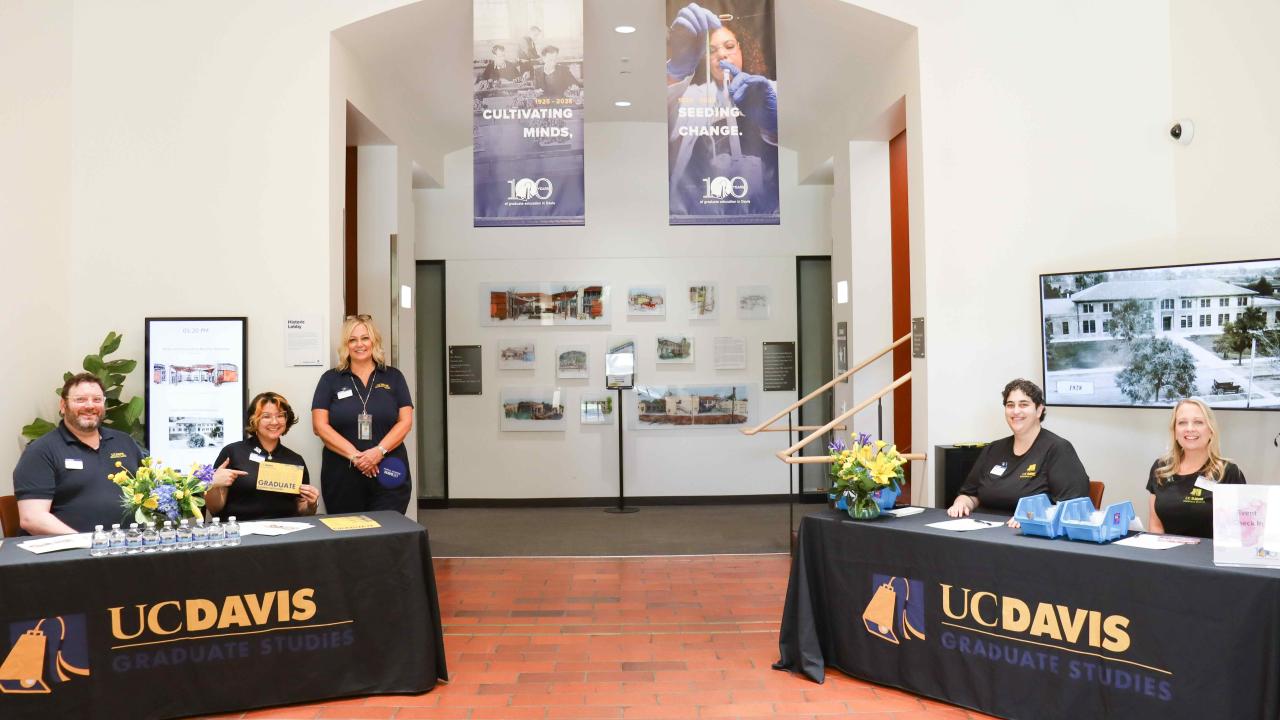
Graduate Studies Celebrates 100 Years of Graduate Education with Centennial Showcase
On June 5, 2026, Walker Hall was transformed into a comprehensive exhibition of graduate student art, research and scholarship to culminate a yearlong celebration of 100 years of graduate education in Davis.
In the fall of 1925, the first 12 graduate students enrolled here to study agriculture. Today, graduate education at UC Davis encompasses more than 6,000 graduate students working across more than 100 graduate and professional degree programs. Sponsored by the Graduate Alumni Network, the Graduate Studies Centennial Showcase captured the spirit of this growth through an event that included an art exhibition, research and scholarly posters, research demonstrations, speeches and other live performances.
During the opening ceremony on the North Lawn, Jean-Pierre Delplanque, Vice Provost and Dean of Graduate Studies, gave a warm welcome to attendees and graduate students. He talked about the "humble beginning" of graduate education in what was then the "University Farm." He said, "The Graduate Studies Centennial Showcase honors this story of our growth by highlighting the impact of this community. I believe that the power of graduate education is that while it is rooted in decades, centuries of prior scholarship it always — and often stubbornly — refuses to be stuck in the past. Graduate education has to look forward because it has to chart new paths of knowledge."

After his opening remarks, Dean Delplanque introduced Chancellor Gary S. May to speak.
"Graduate education plays a vital — and growing — role across our campuses," said Chancellor May, "Graduate students serve as mentors and teachers for our undergraduates, research partners with our faculty, and innovators in their own right. They are empowering students and unlocking research, making a difference right here in California and across the world."
Chancellor May went on to thank the faculty and staff who support graduate students with their well-being, academic success and career advice. After Chancellor May concluded, Dean Delplanque introduced Dr. David Loury, Chair of the Graduate Studies Advisory Board.
Dr. Loury said, "I had the privilege to obtain a doctorate degree from UC Davis 42 years ago. The education and training I received as a graduate student at this institution were instrumental in shaping a three-decade career in research and development. I firmly believe that the graduate education system at UC Davis serves the greater public good by providing a foundation for advancements across nearly every facet of society. For 100 years, graduate education has flourished in Davis, and it can do so for another 100 years as long as there is commitment to its fundamental purpose and support for its mission."
Dean Delplanque then introduced and invited Graduate Student Association President, Luna Loganayagam, to speak. Loganayagam began by talking about the GSA's own history.
"Just last year, the GSA celebrated our 50 year anniversary at UC Davis as well," Loganayagam said. "And for as long as there has been a GSA here, there has been active partnership with campus leadership. It’s in this growing and contentious space that I want to remind us that we are all in an ecosystem: an ecosystem of students, staff, and faculty all working together to support the mission of higher education. In this network of relationships, engagement with graduate students is the best way to calibrate how healthy that ecosystem is."
Jessi Jarrin, third-year MFA in Creative Writing poetry candidate, was then invited to the stage by Dean Deplanque to read some of her poetry. Jessi Jarrin is a former Eugene Cota-Robles Fellow whose work is focused on the ways different types of trauma shape us and how we can better talk about it. She believes in democratizing grief and making healing arts — specifically poetry — accessible to communities without the financial means to participate in creative writing workshops.
Jarrin's poems were titled "Murmuration," "The Distance Between Us and Our Mothers," "Deterrent," and "Tabernacle." After Jarrin shared her final poem, Dean Delplanque thanked the Centennial Showcase sponsor, the Graduate Alumni Network and its Founder and President, Sundeep Dugar, before inviting everyone into Walker Hall for the ensuring reception and exhibitions.
Transforming Walker Hall and Celebrating Graduate Student Achievements

The Centennial Showcase represented a full "takeover" of Walker Hall, featuring graduate student poster presentations, art exhibitions and hands-on research demonstrations. UC Davis leadership, including the Chancellor and Provost, were in attendance, along with emeriti faculty and alumni and supporters of Graduate Studies. The Showcase gave attendees a window into graduate student contributions on campus and helped articulate the much larger impact that this work has on the world.
Poster Presentations

Graduate student poster presenters represented fields ranging from political science and history, to neuroscience and animal biology. Those who participated in the Centennial Showcase were not only able to network and present their research and scholarship, but also communicate the importance of their scholarship and how it contributes to innovations found in everyday life. Graduate education remains a pillar of the UC Davis research enterprise and is vital to the continued success of its academic community. Despite the challenges of recent years, graduate education remains an indispensable part of the university's mission to empower individuals and produce innovations that reach every corner of the world.

Special Collections
In partnership with Dr. Archana Venkatesan, UC Davis professor of religious studies and Faculty Director of the GradPathways Institute, graduate students in religion partnered with the Shields Library Archives and Special Collections to produce an exhibit on the Pierce Family — one of the early founders of Davis and a big proponent of getting a university established here back in the early 20th century.
The Pierce Family emigrated from Wisconsin in 1852 and became active in early Davis life. In addition to developing a large grain farm, the family became involved in the almond growing business. The senior George W. Pierce was an early Justice of the Peace and a public administrator. George Pierce, Jr. became president of the California Almond Growers' Exchange and the foremost advocate of Davisville (the former name of Davis) as the location for the University Farm. Eunice Pierce was a member of the Women's Christian Temperance Union.
The exhibition displayed during the Centennial Showcase included: the 1906 Diary of George W. Pierce, Jr; a 1929 photo of George W. Pierce, Jr. riding an elephant at Kandy, Ceylon; a Blue Diamond Fancy Almonds Box (circa 1920s); a 1923 U.S. patented Almond Bleacher design by George W. Pierce, Jr; George W. Pierce, Jr.'s notes and envelope on Imperialism and the Philippines from February 12, 1929; the 1918 Diary of George W. Pierce, Jr.

Student Parents and Human Development
Graduate students from the Human Development Graduate Group (HDGG) and Development of Externalizing and Self-Control Lab (DESC) demonstrated some of the cognitive tasks they use for young children, as well as their psychophysiological instruments, within the Student Parent Room in Walker Hall.
The Human Development Graduate Group offers interdisciplinary graduate-level training in the study of human development across all domains (biological, cognitive, emotional, physical, social), with an emphasis on the contexts in which development occurs (peers, family, school, community, health & nutrition, policies & programs). Alongside that group, the Development of Externalizing & Self-Control Lab is a research laboratory in the Department of Human Ecology at the University of California, Davis. Led by Dr. Daniel Choe, an Associate Professor of Human Development and Family Studies, the DESC Lab studies young children's and parents' self-regulation, mental health and resilience.

Brain Zoo
Members from the Neuroscience Graduate Group provided interactive demonstrations including a donated human brain that was a small part of the Neuroscience Graduate Group's "Brain Zoo."
The Neuroscience Graduate Group is composed of over 100 faculty members drawn from 20 departments, divisions and sections, including the School of Medicine, the School of Veterinary Medicine, the College of Biological Sciences, the College of Agriculture and Environmental Sciences, and the College of Letters and Sciences.
Designed to demystify neuroscience by giving the public direct, tactile access to comparative neuroanatomy, the "Brain Zoo" enabled participants to hold an actual human brain, learn the different mechanisms that make up the brain, and view other animal brains for comparison.
Fragile Crop Harvest-Aiding Mobile Robots
Graduate students from Stavros G. Vougioukas' lab in the Department of Biological and Agricultural Engineering brought a robot inside of Walker Hall from the Western Center for Agriculture Equipment.
Fragile Crop Harvest-Aiding Mobile Robots, or FRAIL-Bots, is a project that was funded by USDA-NIFA, under the National Robotics Initiative. The robots "transport the strawberries from the worker to the collection station, and also provide empty trays," said Dr. Vougioukas.

These FRAIL-bots are one more step towards understanding and enhancing human-robot interactions. They predict when a picker's tray will be full and ready to be transported, based on the picker's past and current picking speed, and travel to them "pro-actively" to reduce waiting times. While pickers may be intolerant of delays, robots are more patient. And the robot scheduling system performs stochastic optimization in real-time to eliminate picker waiting time and increase harvest efficiency by 10 to 20%.
This research demonstration was especially significant due to Walker Hall's origin as the home of the Agricultural Engineering department. When Walker Hall opened in 1928, it housed faculty and students from agricultural engineering and was a working structure to support the University Farm's core mission, which was to advance the technical and human capacity for agriculture in this abundant region. UC Davis has long touted an impressive history in agricultural machines. The tomato harvester, for example, changed the industry practically overnight. In 1949, UC Davis agricultural engineer Coby Lorenzen and UC Davis vegetable crops researcher Jack Hanna began work on developing a harvester and a tomato variety that could withstand the rigors of mechanical picking. Their work culminated with the commercialization of the tomato harvester in 1959. Now, nearly all of the tomatoes grown in the U.S. for tomato sauce, paste, ketchup, juice and other processed foods are harvested by Hanna and Lorenzen’s machine.

Art and Exhibition Spaces
Curated by AJ Burke, an art history graduate student, participating M.F.A. students in studio art, design, creative writing, as well as one Biochemistry, Molecular, Cellular and Developmental Biology student, showcased their artwork in the "Artists of the Centennial" exhibition. Typically functioning as a conference room, the Gibeling Room at Walker Hall was transformed into a museum space for graduate students to showcase their artwork through educational art books, ceramic tiles, paintings, fused glass, digital art, poems and multimedia.
As Burke details in her curator statement, "Across campus from the STEM heart of UC Davis, the university’s art presence has grown into a West Coast powerhouse. The origins of the Art Studio M.F.A. are rooted deep in the history of graduate education, and each year, it produces intersectional, multimedia artists who take the challenges and topics of the contemporary moment head on. But in the contemporary moment, increasingly we see artists develop from other fields as well, and UC Davis is no exception. Today, we see artwork across media, topics and disciplines that represent the breadth and depth of both the Art Studio M.F.A. and the entirety of graduate education at UC Davis."

Token, 2026"
Design is by nature an interdisciplinary field that touches on many aspects of our lives. Since 1936, a commitment to the well-being of all has guided design at UC Davis, the only comprehensive academic design department in the University of California system. Alongside design, the art studio M.F.A. program in the Department of Art and Art History at UC Davis provides an opportunity for interdisciplinary study in the visual arts. Drawing on the vast resources of a research one university, the program offers M.F.A. students the opportunity to engage in intensive artistic work supported with individual, spacious 24-hour access studios, while interacting with other artists, scholars and STEM professionals across campus. The innovative M.F.A. in Creative Writing program includes both studio instruction and literature courses. Grounded in a belief in the power of various perspectives and experiences, the importance of artistic exploration and the development of vivid and distinctive creative voices, the program offers sustained teaching support for graduate students to gain valuable pedagogical experience and develop meaningful skills through their teaching in this program.
The History of Walker Hall and the Future of Graduate Education

Dedicated as the Agricultural Engineering building in 1928, Walker Hall is one of the oldest buildings on campus. It was re-imagined through extensive renovations and reopened as the Graduate Center at Walker Hall in 2021, making it the first space of its kind in the University of California system. The Graduate Center at Walker Hall is designed to spark interdisciplinary collaboration and strengthen community among graduate students and postdoctoral scholars. Walker Hall is also listed within the UC Davis Library's Historical Information about UC Davis Campus Buildings. Today, it serves as a hub for connection, scholarship and innovation, offering office spaces, meeting and writing rooms, a parent study area, and community gathering spaces. Transforming Walker Hall into a comprehensive exhibition full of graduate student art, research and scholarship to culminate a yearlong celebration exemplified what Graduate Studies stands for and continues to strive for: Cultivating the best learning experience for graduate and postdoctoral students.
Delve Deeper Into the History of Walker Hall
The Newly Launched Centennial Fellowship Acceleration Initiative

During the Centennial Showcase, Graduate Studies was also proud to launch the Centennial Fellowship Acceleration Initiative. While the Centennial Showcase attendees got to see this work first-hand and connect with our amazing graduate students, in his opening remarks Dean Delplanque reiterated that behind every breakthrough, every dissertation and every moment of creativity and discovery is a network of support.
That commitment to supporting graduate students is at the core of our Graduate Studies mission. Graduate education is about far more than earning a degree. It is also about cultivating an environment where students can succeed and belong.
With initiatives such as the Graduate Studies Graduate Student Emergency Fund, partnerships such as the Graduate Student Association Pantry, and the robust commitments of many, Graduate Studies works hard to provide the holistic support our students need and deserve. But we must always continue to do more.
The Centennial Fellowship Acceleration Initiative is a new cycle of a very successful fellowship initiative to support graduate student priorities, such as research and scholarly excellence. Financial hardship should never stand in the way of a student’s future. Through the Centennial Fellowship Acceleration Initiative, donor support can have double the impact and directly expand opportunities for our students.
The Centennial Fellowship Acceleration Initiative invites donors to establish a named endowment to support academic graduate students in any graduate program or area of study. Via this initiative, Graduate Studies provides fellowship support for a period of 10 years allowing the endowment to grow untouched during this time.
One hundred years of graduate education in Davis is a remarkable milestone. While the Graduate Studies Centennial Showcase aimed to capture this special moment, building the next hundred years in partnership with our campus community and our supporters is even more meaningful.
Cultivating Minds, Seeding Change
As Graduate Studies culminates its celebration of 100 years of graduate education in Davis during the 2025-2026 academic year, we remain committed to cultivating the best learning experience for students and scholars in their ongoing pursuit of knowledge and discovery. What will the next 100 years of graduate education look like here? How can we keep growing, changing, and rising to meet new and unforeseen challenges? One thing is certain: the spirit that’s carried us this far and helped fuel each of our staff, faculty, scholars and students — ambition, persistence, curiosity, empathy — will carry our graduate education community forward into even greater heights for generations to come.
Exhibiting Students
A special thank you to the exhibiting graduate students, our campus community, our supporters and our friends for celebrating 100 years of graduate education in Davis with us!
Alex Neupauer - Ph.D. in Integrative Genetics and Genomics
Ana Roden - Ph.D. in Earth and Planetary Sciences
Andy Domokos - Ph.D. in Chemistry and Chemical Biology
Ankita Singh - M.D./Ph.D. in Molecular, Cellular, and Integrative Physiology
Anya Stewart - Ph.D. in Political Science
Aubrey Golden - Ph.D. in Human Development
Brent Horning - Ph.D. in Study of Religion
Caleb Huntington - Ph.D. in Integrative Pathobiology
Camille Nava - M.F.A. in Creative Writing
Chloe Pressley - Ph.D. in Pharmacology and Toxicology
Christian Bernal-Córdoba - Ph.D. in Animal Biology
Daniel Castaneda - Ph.D. in History
Daniel Martin - Ph.D. in Electrical and Computer Engineering
Daniyel Souza-Wiggins - M.F.A. in Creative Writing
Danny Dyer - Ph.D. in Study of Religion
Daphne Condon - Ph.D. in Energy Systems
Dawn Cayabyab - Ph.D. in Animal Biology
Denise Yamhure Ramirez - Ph.D. in Evolution and Ecology
Doreen Joseph - Ph.D. in Computer Science
Florencia Milito - M.F.A. in Creative Writing
Gabriel Yee - Ph.D. in Study of Religion
Gemma Padilla - M.F.A. in Studio Art
Grace Chen - M.F.A. in Design
Grace Hayes - Ph.D. in English
Hussain Chharawalla - Ph.D. in Nutritional Biology
Indrani Vijaya Amrit Maharaj - Ph.D. in Study of Religion
Jessi Jarrin - M.F.A. in Creative Writing
Jonathan Mo - M.D./Ph.D. in Biomedical Engineering
Julio Rodriguez - M.F.A. in Studio Art
Kayla Thomas - Ph.D. in Immunology
Kelly Chau - Ph.D. in Integrative Genetics and Genomics
Levi Keatts - M.F.A. in Studio Art
Lulu Smith - M.F.A. in Studio Art
MJ Marshall - D.V.M./Ph.D. in Molecular and Cellular Biology
Maite Serantes Laforgue - Ph.D. in Food Science
Malavika Kannan - Ph.D. in Study of Religion
Mohammad Minhajul Islam - Ph.D. in Chemistry
Neuroscience Graduate Group
Nick Peoples - Ph.D. in Population Biology
Nicole Rodrigues - Ph.D. in Biochemistry, Molecular, Cellular and Developmental Biology
Niki Gallardo - M.F.A. in Design
Olivia Feldman - Ph.D. in Ecology
Sadia Gul - Ph.D. in Energy Systems
Sarah Blecksmith - Ph.D. in Nutritional Biology
Shruti Arora - Ph.D. in Neuroscience
Sierra Faust - M.F.A. in Studio Art
Wonjin Kim - M.F.A. in Design